
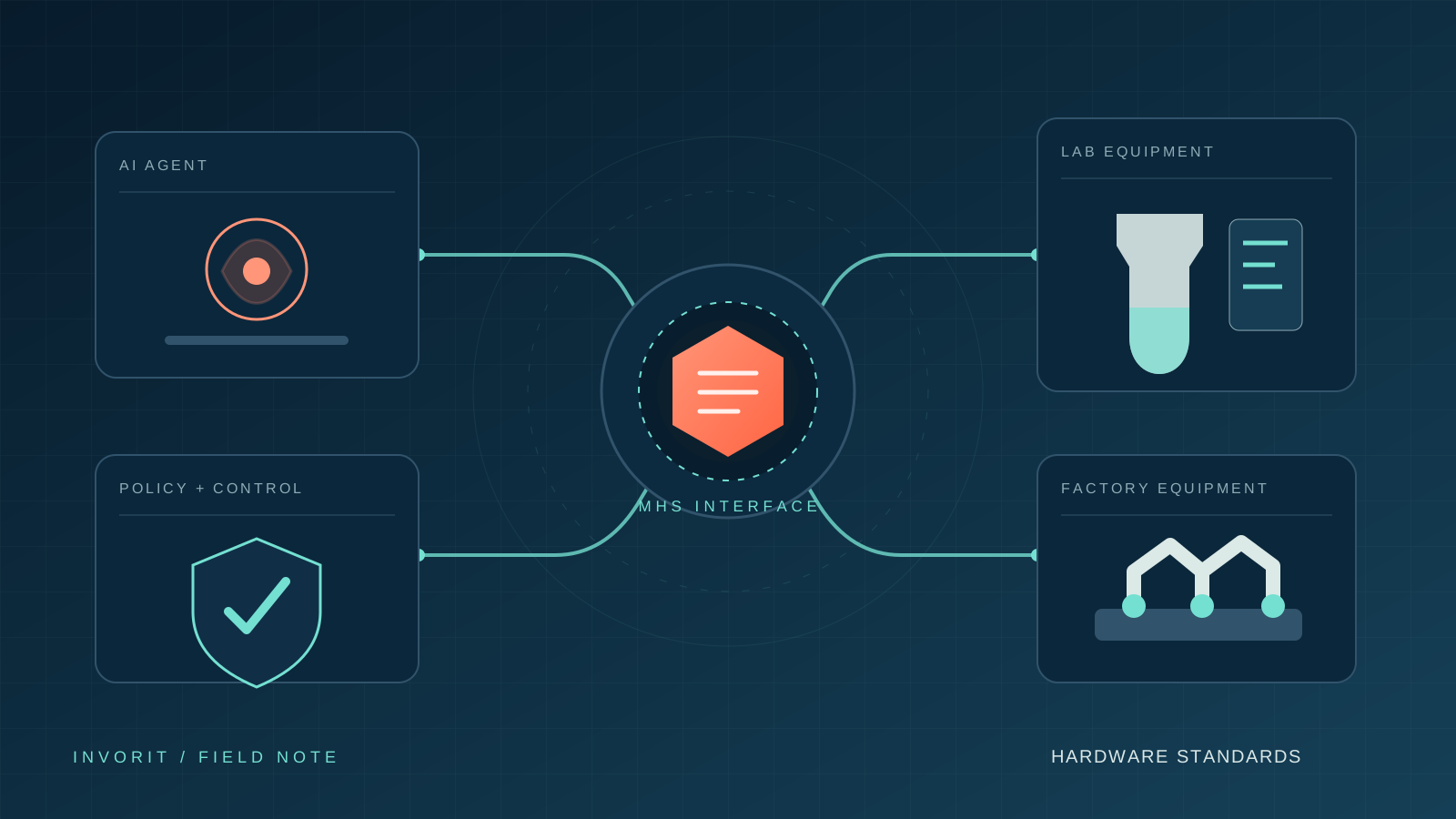
Software agents can already plan experiments, interpret work instructions and reason over production evidence. Their path into the physical world remains fragmented. Every robot, instrument, machine and controller exposes a different command set, data model and security boundary. MHS addresses this integration gap by proposing a consistent way for equipment to declare what it is, what it can do and how software may interact with it.
A contract between intelligence and hardware
The useful idea behind MHS is not that every device should behave identically. A liquid handler, torque tool, CNC machine and environmental chamber have fundamentally different physics. The value lies in giving them a common contract for discovery, capability description, state, authorization and action results.
Instead of encoding undocumented device assumptions inside an agent, an adapter compatible with MHS can publish a description that machines can read. The agent can determine whether a capability exists, inspect the required parameters and ask for an allowed action through a governed interface.
A model may propose intent, but a deterministic execution layer must validate that intent against identity, state, limits and safety policy before hardware moves.
What equipment must describe
A command name alone is not enough for physical operation. “Set temperature,” “move axis” or “start cycle” becomes safe and portable only when its operating meaning is explicit. A robust MHS equipment description should make several classes of information available:
- Identity: equipment type, manufacturer, model, firmware, location and trusted endpoint.
- Capabilities: available operations, required arguments, units, valid ranges and expected results.
- State: current mode, readiness, active recipe, alarms, occupancy and relevant sensor values.
- Constraints: prerequisites, forbidden combinations, timing limits and actions requiring approval.
- Evidence: request identity, policy decision, command acknowledgement, result and device telemetry.
These descriptions also need versioning. If a firmware update changes a parameter, an agent should not silently continue using an old assumption. Compatibility must be checked at connection time and recorded with the operation.
Discovery must establish trust
Convenient discovery can also enlarge the attack surface. An agent should not operate a device merely because it appears on a network and publishes a compatible descriptor. The discovery process needs authenticated device identity, signed or otherwise trusted capability information, endpoint allowlists and an ownership model.
The reverse is equally important. Equipment or its gateway must know which agent is making a request, on whose behalf it is acting and which scope has been granted. Temporary authorization limited to a specific capability is safer than a standing credential with broad machine access.
Separate reasoning from execution
Language models are useful for interpreting goals and composing plans, but physical control needs predictable behavior. A safe architecture therefore separates the probabilistic agent from the component that executes commands. The agent submits a structured request; a policy and control layer evaluates it; deterministic software then communicates with the equipment.
That layer should enforce parameter bounds, prerequisites based on machine state, rate and time limits, sequencing rules and required human approvals. Commands should have clear timeout, cancellation and idempotency behavior so that a retry cannot accidentally repeat a physical operation.
Where MHS fits in a factory
MHS should sit above the protocols already responsible for reliable machine communication. It does not replace fieldbus networks, OPC UA, vendor robot APIs, PLC logic or functional safety systems. An adapter or edge gateway can map a standardized capability request onto those existing interfaces while preserving local control ownership.
A practical stack has five parts: an equipment adapter close to the asset; a registry of trusted capabilities; an agent host that develops intent; a policy service that approves or rejects requests; and a deterministic executor that invokes the existing automation interface. Observability and audit evidence span every layer.
Start narrow, observable and reversible
The first MHS deployments should not begin with unrestricted autonomous control. Discovery with no write access, status retrieval and guided diagnostics create value while teams establish identity and data quality. The next step can be reversible actions with limited consequences in a bounded cell or laboratory workflow. Operations with greater impact should follow only after failure modes, approvals and recovery procedures are proven.
Success should be measured by more than whether an agent completed a task. Teams should monitor denied requests, stale descriptions, authorization failures, command latency, equipment exceptions, operator interventions and recovery outcomes. Those signals reveal whether the interface is genuinely safe and maintainable.
A standard is the beginning, not the safety case
MHS can remove a large amount of bespoke integration work and make hardware capabilities legible to AI systems. It cannot make an unsafe machine safe, resolve ambiguous process ownership or decide how much autonomy an operation should permit. Those remain engineering and governance responsibilities.
The opportunity over time is significant: reusable equipment interfaces can let factories and laboratories compose intelligent workflows without rebuilding every connection. Real adoption, however, will depend on conservative defaults, strong conformance testing, clear vendor support and architectures that keep deterministic control in charge of physical execution.
This perspective discusses MHS as an emerging specification using its stated August 27, 2026 introduction. Technical requirements and implementation details should be checked against the latest official specification before deployment.