Manufacturing teams work across SOPs, maintenance histories, alarms, quality records, production systems and informal knowledge. AI agents can reduce the effort needed to find and connect that information. They can also create risk if a fluent answer is mistaken for evidence or an unconstrained model is allowed to act directly on operational systems.
Start with assistance, not autonomy
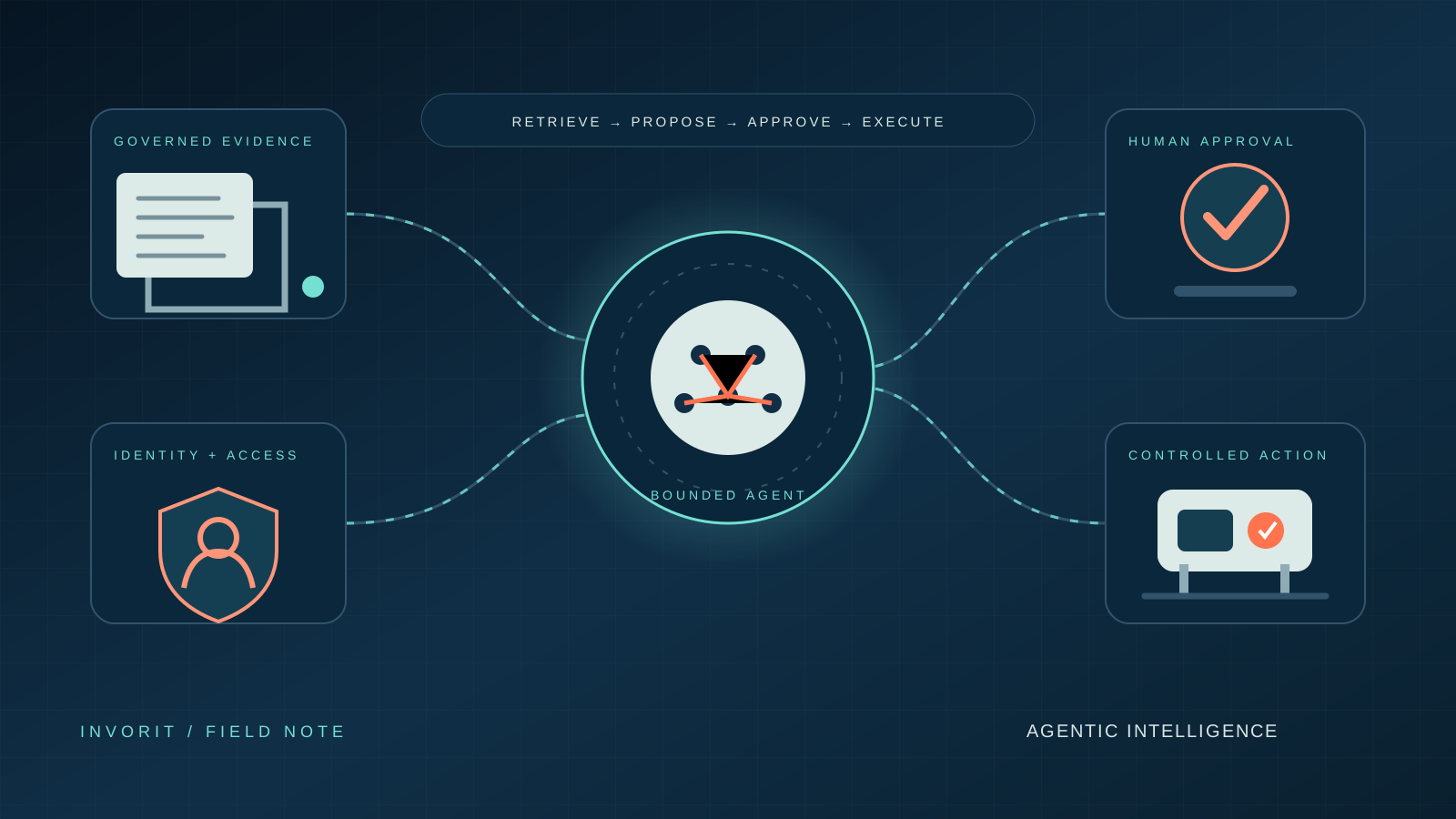
The safest useful starting point is often a copilot that only reads information. It helps a person find approved information, summarize an event, compare evidence or prepare a draft. The user remains responsible for the decision while the system demonstrates whether it can retrieve the right context consistently.
Good initial use cases have a clear user, bounded information domain and observable outcome. Examples include locating the correct troubleshooting procedure, summarizing an asset event, collecting evidence for a quality deviation or drafting a maintenance work request for review.
Increase authority only after the agent has earned trust at a lower level of consequence.
Ground responses in governed evidence
A general language model does not know the current state of a particular line, which SOP revision is approved or whether a maintenance instruction applies to a specific asset. An industrial agent needs retrieval across authorized sources such as controlled documents, historian events, CMMS records, MES context and quality evidence.
Retrieval should preserve source identity, timestamps, document versions and access permissions. The answer should cite the evidence it used and distinguish retrieved facts from generated interpretation. If sufficient evidence is unavailable or conflicting, the system should say so rather than filling the gap.
Build identity and permissions into every step
The agent should act as the authenticated user or an explicitly defined service identity. Retrieval must respect document and system permissions. Tool access should be limited to an approved list for each role, site and task. Sensitive fields should be filtered before they enter prompts or logs.
This prevents a conversational interface from becoming a path around existing controls. It also creates a clear audit record: who asked, what evidence was retrieved, which model and prompt version were used, what the system proposed, and who approved any resulting action.
Separate reasoning from execution
Language models are useful for interpreting requests, connecting unstructured information and explaining options. Deterministic services should validate parameters, enforce business rules and execute transactions. The model can propose a work order; a controlled integration should verify required fields, permissions and asset identity before creating it.
Actions with greater consequences require explicit approval. A maintenance recommendation may need technician review. A change to the production plan may need planner approval. Changes to control parameters should remain inside established engineering and safety controls rather than being issued directly from generated text.
Evaluate the workflow under realistic conditions
Fluency is not the same as correctness. Evaluation should use representative operational questions, ambiguous requests, missing evidence, conflicting documents and attempted actions outside the user’s permissions. Measures should cover retrieval quality, citation support, task completion, refusal of unsafe actions and the time a person saves.
Testing must continue after launch. Source documents change, integrations fail, model behavior shifts and user requests reveal new edge cases. Versioned evaluations and monitored feedback help determine whether the system remains within its intended operating boundary.
Design for graceful limits
A trustworthy agent knows when to stop. It should request clarification when asset identity is unclear, decline an action when permissions are missing, surface conflicting evidence and hand control to a person when consequence or uncertainty exceeds policy.
The objective is not an agent that appears autonomous. It is a dependable workflow that helps people reach decisions with better support and complete approved work with less friction. Evidence, permissions, deterministic tools and human responsibility are what make that possible.